
Thermal Spray Coating Services
Wear and Corrosion Protection for Industrial Parts
A&A Coatings has spent more than 70 years coating metal parts that wear out too fast. Our shop handles shafts, rolls, pump housings, and valves. When one of those parts comes in scored, pitted, or cracked, we can often bring it back to service.
Need a quote? Call 888-725-0150 or send us a request. Our team replies the same business day.
What We Do
Worn parts cost money. The replacement itself is only part of it. The downtime while you wait for delivery is the rest.
Our work starts with a high-performance coating sprayed onto the metal surface. The coating restores what was lost. It also stands up to abrasion, corrosion, heat, and impact. In plenty of cases, a coated part lasts longer than the original.
The plant was built for coating work. Grinding, finishing, and machining happen in the same building. Your part stays on our floor from start to finish. It does not get shipped to a second shop. It does not sit in someone else’s queue.
Most jobs fall into one of three groups.
Repair. A worn shaft or a pitted roller gets built back to spec. Far cheaper than buying new.
Prevention. Coat a new part before it goes into service, and you can add years to its life. Insurance you can measure.
Sizing. A part machined too small does not have to be scrap. We add material, then cut it back to the right size.
How Thermal Spray Works
Before we get into the four processes, here is the basic idea behind all of them.
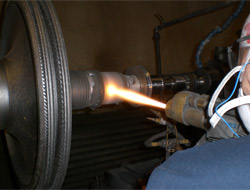
Thermal spray takes a coating material, usually in powder or wire form, and heats it until it softens or melts. Then it gets pushed onto the surface of your part at high speed. The particles flatten on impact and lock onto the base metal. Layer builds on layer until the coating reaches the thickness we need.
No welding. No heat distortion across the whole part. The base metal stays cool enough that its properties do not change.
The bond happens in two ways. Mechanical bonding is when particles grip the roughened surface, like paint on sandpaper. Metallurgical bonding is when the coating and base metal fuse together at the atomic level. Spray and fuse does the second one. The other processes lean on the first, though HVOF gets close to a true metallurgical bond thanks to the particle speed.
That is the whole concept. Simple enough. The details are where the craft lives.
Our Thermal Spray Processes
Thermal spray is not one method. It is a family of methods. Each one uses a different heat source and a different way of pushing material onto the surface. The right choice depends on your part, your budget, and what is killing it.
Here are the four processes we specialize in.
HVOF Coating
HVOF stands for High Velocity Oxygen Fuel. A fuel gas burns with oxygen inside a chamber, and the flame shoots out at supersonic speed. Powder gets fed into that stream and hits the part fast. Very fast.
What does that give you? A dense coating. Low porosity. Strong bond to the base metal. HVOF shines when a part faces both wear and corrosion at the same time. Hydraulic rods, pump shafts, and valve stems are common candidates.
Metalizing
Metalizing covers flame spray and arc spray. A wire or powder is melted and sprayed onto the surface. It is a flexible, cost friendly option for large parts and high-volume work. Metalizing works well for corrosion barriers on bridges, tanks, and structural steel, and for general rebuild work on industrial equipment.
Plasma Spray Coating
Plasma spray uses an electric arc to create a superheated gas. Temperatures can top 15,000 degrees Fahrenheit. That heat lets us spray materials that other processes cannot melt, including ceramics and high temperature alloys.
Ceramic coatings from plasma spray are a go to answer for heat barriers and electrical insulation. They also hold up well against abrasive wear at high temperatures. Think furnace parts, exhaust components, and turbine sections.
Spray and Fuse Hardfacing
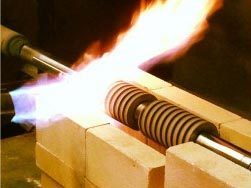
Spray and fuse takes a different path. We spray the alloy onto the part, then fuse it with a torch or furnace. The result is a metallurgical bond, not just a mechanical one. The coating becomes part of the surface.
This process is built for extreme wear. Mining equipment, pump impellers, and valve seats often get spray and fuse hardfacing. It is not the right fit for every part, but when abrasion is severe, it holds up.
Materials We Apply
The coating material matters as much as the process. We stock and spray a wide range of materials, and we help you pick the right one for your conditions.
Tungsten carbide. The go to choice for severe abrasion and erosion. It shows up on pump sleeves, cutting tools, and any part that meets grit or slurry head on.
Chromium carbide. Handles wear and corrosion at the same time, even at high heat. Common on turbine blades, boiler tubes, and valve parts that see hot gases.
Nickel based alloys. A workhorse for corrosion resistance and rebuild work. Used on pump housings, shafts, and seals that face chemicals or seawater.
Cobalt based alloys. Built for high temperature wear. Found on exhaust valves, hot dies, and furnace rolls where other materials soften and fail.
Aluminum oxide and zirconia ceramics. Heat barriers and electrical insulation. Used on furnace linings, exhaust ports, and parts that must stay cool or non-conductive.
Molybdenum. A scuff fighter. Common on piston rings, synchro parts, and anywhere metal slides against metal under load.
Copper and aluminum. Chosen for electrical and thermal conductivity. Used on contacts, bus bars, and heat transfer surfaces.
Stainless and carbon steels. The general purpose picks for repair and dimensional restore. Good for shafts, rolls, and housings that need a durable surface at a fair price.
Not sure what fits your part? Send us the details. We will tell you what we would use and why.
Industries We Serve
Our coatings show up in plants and equipment across many sectors. A few of the main ones:
Oil and gas. Pump shafts, valve components, and drill tools take a beating. Coatings keep them running.
Power generation. Boiler tubes, turbine parts, and ash handling equipment face heat and erosion every day.
Steel and metals. Rolls, guides, and furnace components wear fast in these plants. Hardfacing and carbide coatings help them last.
Mining and aggregates. Crusher parts, screens, and slurry pumps see brutal abrasion. This is where spray and fuse earns its keep.
Pulp and paper. Rollers and dryer sections deal with corrosion and wear at the same time.
Aerospace. Tight tolerances and high value parts call for precise coating work and careful finishing.
Automotive and heavy equipment. Shafts, cylinders, and engine components get rebuilt or protected for longer service.
Chemical processing. Corrosion resistant coatings protect vessels, mixers, and pumps from aggressive media.
Hydraulics. Rods, cylinders, and pistons need a smooth, hard surface to hold up under pressure. HVOF and plasma coatings keep them sealing tight and running clean.
If your industry is not on this list, it does not mean we cannot help. Call and ask. Odds are we have seen your problem before.
Certifications and Quality
Quality is not a slogan here. It is a process.
A&A Coatings holds AS9100 and ISO 9001 certifications. We also meet NADCAP requirements for coatings work. These are not easy credentials to earn, and we keep them current on purpose.
What does that mean for you? It means documented procedures. It means traceable materials. It means a paper trail that holds up to an audit.
Our in-house lab checks coating thickness, bond strength, hardness, and microstructure. We test before the part ships. Not after it fails.
Turnaround and Capacity
We know downtime costs money. A part sitting in a shop is a part not making you money.
Our typical turnaround runs five to ten business days for standard coating jobs. Rush service is available when you need it. Tell us your deadline up front, and we will tell you straight if we can hit it.
Scheduling works like this. When your quote is approved, we slot your job into the production board based on material, process, and finishing needs. Jobs that share a setup run together, which saves time and keeps costs down. If you send the same part every month, we can set up a standing run and hold your spot on the calendar.
Rush jobs jump the line. That means we shuffle other work to make room. We do not promise rush on every job, but when we say yes, we mean it.
For high volume production work, we set up dedicated runs and hold inventory of common materials. Our in-house machining lines cut lead time further, because coated parts move straight to grinding and finishing without a shipping delay. That keeps lead times short and pricing steady.
How to Get a Quote
The quote process is quick. Here is what we need from you:
Part description. What is it, what does it do, and what is it made of?
The problem. Wear, corrosion, heat, or a mix. Photos help.
Specs and drawings. Tolerances, dimensions, and any finish requirements.
Quantity. One part or one thousand.
Timeline. When do you need it back?
Send those details through our quote form, or call 888-725-0150. A real person will review your request and get back to you the same business day.
No pushy sales calls. No runaround. Just a straight answer on what we can do, what it costs, and when you will get your parts back.
Why Work With A&A Coatings
Plenty of shops can spray a coating. Fewer can do it right, do it on time, and stand behind the work.
Here is what you get with us:
- 70 plus years of coating experience
- Four core processes under one roof
- Full machining and grinding in house
- AS9100, ISO 9001, and NADCAP credentials
- In house lab testing on every job
- Fast turnaround with rush options
- Same day quote response
Your parts work hard. Give them a surface that works harder. Call A&A Coatings today at 888-725-0150 or fill out the form to get your quote started.
Ready to stop replacing parts and start protecting them?
Call 888-725-0150 or request a quote online. We will help you pick the right coating, the right process, and the right schedule for your operation.


A&A Coatings has the right machining, engineering & laboratory infrastructure combined with a highly focused workforce that can bring more efficiency into your processes and lower your replacement or maintenance costs significantly.
