
HVOF Coating Services
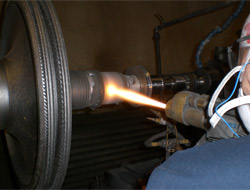
When a shaft scores, a valve ball pits or a hydraulic rod wears through its chrome, most plants have two options on the table: buy a new part or send the old one out for plating again. High Velocity Oxygen Fuel spraying is the third option, and often the better one. A&A Coatings delivers HVOF coating services that lay down dense carbide and metal layers harder than HV 1000, bonded tightly enough to take impact, fretting and abrasive grit.
We have sprayed industrial coatings in South Plainfield, New Jersey, since 1944. HVOF is one of four thermal spray processes we run here, and the grinding and lapping that finish an HVOF part happen in the same building.
How the HVOF Process Works
Inside an HVOF gun, fuel and oxygen burn in a small chamber. The exhaust leaves the nozzle faster than sound, and we feed powder straight into it.
Older thermal spray methods leaned on heat. They melted particles completely and let them splat onto the part. HVOF leans on speed instead. The particles only soften, but they hit so hard that the impact itself forges the bond and squeezes out most of the porosity.
That is why HVOF coatings come out so dense. It also explains why carbides survive the trip so well. The powder spends very little time in the flame, so less carbon burns off and the coating keeps its wear resistance when the part runs hot.
Advantages of HVOF Coatings
In practice, customers choose HVOF for a handful of reasons. Carbide coatings run harder than HV 1000. Our tungsten carbide bonds to low carbon steel at more than 12,000 psi, and our chromium carbide carries less than half a percent porosity by volume. With so few open paths, process fluids have a hard time reaching the base metal.
The as-sprayed surface is also fine. Plenty of parts need only light grinding, and a few go into service straight from the booth. Add low compressive stress and strong particle-to-particle cohesion, and you get a coating that holds together under load.
HVOF as a Hard Chrome Replacement
Hard chrome plating relies on hexavalent chromium, and OSHA and the EU REACH program restrict its use. That has pushed many plants to look for a hard chrome replacement that wears at least as well. HVOF carbide is the usual answer.
We developed our tungsten carbide-nickel superalloy for exactly this job. It is qualified under MIL-STD-1687A as an alternative to chrome plating. In field tests, its fatigue properties matched or beat chrome, and in ASTM B117 salt fog testing it resisted corrosion several times better than chrome plating.
The U.S. Navy has relied on it. Lift fan shafts from the Navy’s LCAC hovercraft reached us with damaged seal contact areas and bearing journals. We rebuilt those areas with HVOF tungsten carbide-nickel superalloy, a job documented in our Navy LCAC lift fan shaft case study. The repair cost less than new shafts, and the coating left them tougher against wear than they were originally.
HVOF Materials We Spray
Four HVOF powders cover most of what comes through our door. When a specification calls for a different composition, we can usually source it.
Tungsten Carbide
Our HVOF tungsten carbide is a 12% cobalt grade. Among HVOF coatings, it has the best low temperature resistance to abrasive wear, so it is our pick when grit, slurry or hard particles are destroying the part. It measures about Rc 60 and laps down to a 1 to 3 microinch finish. We keep it thin, 0.025 inch or less, because thicker carbide layers tend to crack.
Tungsten Carbide-Nickel Superalloy
This is the chrome replacement coating described above. HVOF tungsten carbide-nickel superalloy stands up to abrasive grains, hard surfaces, fretting and submerged salt water. We spray it on hydraulic rods, compressor rods, gate valves, ball valves, pump rotors and downhole drilling components.
Chromium Carbide
Our HVOF chromium carbide blends chromium carbide and nickel chromium at 75/25. It keeps its hardness when hot, so we recommend it for wear between 1000°F and 1500°F. Tensile bond strength tops 12,000 psi.
Aluminum Bronze
HVOF aluminum bronze is the soft-bearing choice. It machines, mills, drills and taps easily and can be built up past 0.250 inch. We use it to restore worn or mismachined non-ferrous parts and to fight fretting and cavitation.
Surface Preparation and Finishing
A coating can only be as good as the surface below it. Our HVOF carbides bond on their own to mild steel and to titanium once a light grit blast has removed the surface oxides. Titanium needs careful preheating so those oxides do not grow back before we spray.
Finishing is where HVOF work is won or lost. Carbides are too hard for ordinary cutting tools, so we grind them with diamond wheels under flood coolant. We rough grind at 150 grit, finish at 400 grit and keep infeed to 0.0005 inch per pass or less. For seal surfaces and precision rods, lapping then takes tungsten carbide down to 1 to 3 microinches.
Aluminum bronze is the odd one out. We machine it with a carbide tool bit, and it can be milled, drilled and tapped much like solid bronze.
Since all of this happens under one roof, a coated part moves from the spray booth to the grinder without being boxed up and shipped.
Choosing HVOF or Another Process
HVOF is not the answer for every part, and we will say so when it is not.
Compared with plasma spray, HVOF runs cooler and cannot melt ceramics, so alumina, chromium oxide and thermal barrier work goes to plasma. For carbides and metals that need the highest density, HVOF usually comes out ahead.
Metalizing with wire arc or flame spray covers large areas at low cost and suits corrosion barriers on structural steel, but it does not approach HVOF density or hardness.
HVAF burns fuel with air rather than oxygen and runs cooler still. Our article on the HVAF coating process lays out the tradeoffs.
Spray and fuse hardfacing and weld overlays form a metallurgical bond and can be built much thicker. The catch is heat. They put far more of it into the part, while HVOF keeps precision components cool and straight.
Common HVOF Applications
We regularly coat hydraulic and compressor rods, pump shafts, sleeves and rotors, ball and gate valves, aircraft landing gear, Pelton turbine components, calender rolls and downhole drilling tools. Restoring worn or mismachined parts to size is a large share of the work too.
Racing hardware has gone through our shop as well. We applied HVOF tungsten carbide to pistons and piston rods in the hydraulic systems of Oracle Team USA’s catamaran for the 2017 America’s Cup, as described in our ship piston rods case study.
Industries We Serve With HVOF
HVOF jobs reach us from defense, marine, aerospace, oil and gas, power generation, pulp and paper, and general manufacturing. What they have in common is a valuable part that wears out faster than anyone wants to pay for. Typical jobs include hydraulic rods and valve components for marine and Navy work, rolls for mills, and landing gear or rotating equipment that needs to go back to drawing dimensions.
Why Work With A&A Coatings
The plant runs seven spray coating booths. Machining, grinding and lapping are in house, with turning up to 48 inches in diameter and grinding up to 30 inches. Our facility is certified under MIL-STD-1687A, the Navy thermal spray coating standard, and our quality system is written to MIL-I-45208 and has been audited by government agencies and prime contractors. A&A Coatings is also a recipient of a U.S. Department of Defense Achievement Award.
Request an HVOF Coating Quote
Send a drawing or photo, the base material, what is wearing the part out and the finish you need, along with quantity and delivery date.
Upload files up to 8 MB on our quote form, call 888-679-5460 or contact our sales team.
FAQs
What does HVOF stand for?
High Velocity Oxygen Fuel. Fuel and oxygen burn in a combustion chamber and leave the gun at supersonic speed. Powder fed into that stream strikes the part hard enough to forge a dense, well-bonded coating with very little porosity.
Can HVOF replace hard chrome plating?
In many applications, yes. Our HVOF tungsten carbide-nickel superalloy is qualified under MIL-STD-1687A as an alternative to chrome plating. Field tests show fatigue properties equal to or better than chrome, and salt fog testing showed corrosion resistance several times greater.
How thick can an HVOF coating be?
Our tungsten carbide and chromium carbide are meant for thin layers of 0.025 inch or less, since thicker carbide deposits risk cracking. That depends on the material. HVOF aluminum bronze can go past 0.250 inch when a part needs dimensional restoration.
How hard are HVOF coatings?
Carbide HVOF coatings exceed HV 1000. Our tungsten carbide measures about Rc 60, and the tungsten carbide-nickel superalloy Rc 55 to 60. That hardness, combined with low porosity, is why HVOF carbides outlast many plated and welded surfaces.
Will HVOF spraying distort my part?
Compared with welding or spray and fuse, HVOF keeps the substrate cool, so rods, shafts and valve balls hold their shape. We grit blast the surface, spray, then grind or lap the coating to your finished dimension in house.
Call 888-679-5460 to request a quote with A&A Coatings.
