Ceramic Thermal Spray Coatings: A Complete Guide to Oxide Families, Selection, and Applications
Ceramic coatings fix problems that metal cannot solve alone. They take heat that would soften steel. They stop electrical current. They hold up against chemicals that eat through alloys. The coating sits on the surface of your part and does the work there.
A&A Coatings has sprayed ceramics for over 70 years. Plasma spray and HVOF are our two main processes. Grinding and machining happen here too, so your part does not leave the building between steps. Read on and you will know which family to ask about when you call.
Need a quote? Call 888-725-0150 or send us a request. Our team replies the same business day.
Why Ceramics?
Start with the basics. Metals carry heat. They carry electricity. They corrode. Ceramics do not.
That is why ceramics show up in thermal barriers, electrical insulation, and chemical plant equipment. They do not replace the metal. They let a steel part do something steel cannot do by itself.
There is one problem. Ceramics are brittle. They do not bend. They crack. That is why every ceramic coating we spray has a thickness ceiling, and why we ask about impact loads before recommending anything. Get the service conditions right, though, and a ceramic coating can outlast bare metal by years.
Ceramic vs. Cermet: What Is the Difference?
Buyers ask this one a lot. It comes down to ingredients.
Ceramic coatings are all ceramic. Aluminum oxide, chromium oxide, zirconia, materials like those. They hold up well against heat, they do not conduct electricity, and they resist most chemicals. Brittle means they handle pressing and sliding well. Drop something on them and they can crack.
Cermet coatings mix ceramic and metal. Tungsten carbide with a cobalt or nickel binder is the one most people have seen. The metal holds the ceramic grit together. That is what makes a cermet tough. Hit it with something hard and it dents. Hit a pure ceramic the same way and it shatters.
So which one fits your part? Fighting heat, current, or chemicals? A ceramic is usually the right call. Fighting impact and heavy wear? Look at cermets instead. If both are in play, we can talk through layered approaches where a cermet takes the wear and a ceramic goes on top as the barrier.
The Oxide Families We Spray
Ceramic coatings fall into families. Each family has a personality. Some are hard. Some are heat resistant. Some are chemically inert. Knowing which family fits your problem is the first step.
Aluminum Oxide
Alumina is the workhorse. It is hard, chemically stable, and holds up at high temperatures. It also has strong dielectric properties, which makes it a go-to for electrical insulation.
Pure alumina can be brittle. When toughness matters more than maximum hardness, we blend it with titanium dioxide. The blend is Alumina-Titania, and it keeps most of the hardness while adding impact resistance.
Common uses: electrical insulators, wear plates, pump components.
Chromium Oxide
Chromium oxide holds the top spot for hardness in our lineup. It wears slowly against abrasive grain and slides against hard counterfaces with low friction. The self-mating trait helps when two coated parts run face to face.
Chemically, it stands up to acids and caustics. Seal it and it handles corrosive service in the 177 to 205°C (350 to 400°F) range. For pure wear resistance, the limit sits at 540°C (1000°F).
Common uses: pump seals, textile guides, wear plates, hydraulic rods.
Titanium Dioxide
Titania is not the hardest ceramic, but it takes the smoothest finish. Ground finishes reach 6 to 8 microinches aa, which is smooth for any coating, let alone a ceramic.
It resists abrasive grains and hard surfaces below 540°C (1000°F). And it has a trait the other ceramics do not. Certain wavelengths of light trigger a reaction on its surface that breaks down organic residue. That trait is why it appears in self-cleaning glass and exterior tiles.
Common uses: textile rollers, seal faces, print rollers, medical and lab equipment.
Zirconia and Yttria-Stabilized Zirconia (YSZ)
Zirconia is the thermal barrier ceramic. It conducts heat poorly and holds up under thermal cycling. Yttria is added to stabilize the crystal structure so the coating does not crack during service.
This family is the standard choice for thermal barrier coatings, or TBCs. It shows up in turbine blades, piston crowns, and exhaust components.
Zirconia-Titania-Yttria Composite
This three-part blend combines the thermal barrier strength of zirconia with the wear resistance of titania and the stability of yttria. The composite keeps working at temperatures that would soften most metals. It also survives rapid cooling without cracking, which is rare for a ceramic.
Bond strength is 5000 psi on grit blasted low carbon steel, the strongest of any coating we list. Thickness limit goes up to 0.050 inch, the highest in our lineup.
Common uses: diesel piston rings, crowns, cylinder liners, exhaust valves, turbine blades.
Selection by Property
Different jobs call for different ceramics. Here is a quick map from problem to material.
| Your Problem | Best Ceramic Family | Why |
|---|---|---|
| Abrasive wear, hard surfaces | Chromium oxide | Hardest in the lineup, Rc65 to Rc72 |
| Thermal barrier, high heat | Zirconia / YSZ | Low thermal conductivity, thermal shock resistant |
| Wear plus heat | Zirconia-Titania-Yttria Composite | Holds hardness at 1095°C, resists oxidation |
| Smooth finish, low friction | Titanium dioxide | Grinds to 6 to 8 microinches aa |
| Electrical insulation | Aluminum oxide, Alumina-Titania | High dielectric strength |
| Chemical resistance | Chromium oxide (sealed) | Insoluble in acids, alkalis, alcohol |
| All-round wear | Alumina-Titania | Harder than titania, tougher than pure alumina |
If your part faces more than one threat, say so. Wear plus heat plus corrosion is common, and the material choice changes when conditions stack.
Process Options
A&A Coatings offers four thermal spray processes. Ceramics are almost always applied with plasma spray. That is the process that reaches the temperatures needed to melt ceramic powder.
Plasma Spray
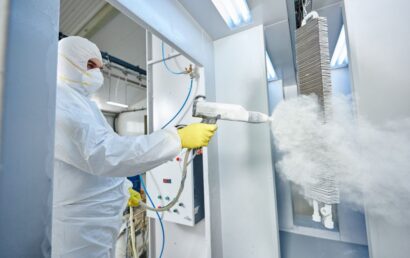
This is our primary ceramic process. An electric arc creates a superheated gas. Powder feeds into the plasma jet, melts, and hits the part at speed. The result is a dense ceramic coating with a strong mechanical bond.
Plasma spray works with the widest range of ceramic materials. It is the right choice for thermal barriers, dielectric coatings, and wear surfaces.
HVOF
HVOF is for metallic and cermet coatings. It produces dense, high-bond coatings with low porosity. We use it for tungsten carbide and similar materials where maximum wear resistance is needed.
Metalizing
Flame spray and arc spray. Cost-effective for large parts and high-volume work. Used for corrosion barriers and rebuild work.
Spray and Fuse
The coating is sprayed, then fused with a torch or furnace. The result is a metallurgical bond. Used for hardfacing alloys in extreme wear applications.
Ceramic coatings are almost always plasma sprayed. The other processes handle metals and cermets.
Industries Served
Ceramic thermal spray coatings show up across many industries. The list below is not exhaustive, but it covers the main ones we serve.
Aerospace. Turbine blades, combustion liners, and exhaust components. Zirconia-based thermal barrier coatings are standard in hot sections.
Automotive and Diesel. Piston rings, crowns, cylinder liners, and valve components. The zirconia-titania-yttria composite was built for these parts.
Power Generation. Gas turbine hot section parts. TBCs extend service intervals and improve efficiency.
Pulp and Paper. Rollers and dryer sections. Chromium oxide and alumina-titania handle the wear and corrosion.
Textiles. Thread guides, rollers, and contact points. Titanium dioxide and chromium oxide give smooth, wear-resistant surfaces that keep fiber running clean.
Chemical Processing. Pumps, valves, and mixer components. Sealed chromium oxide resists corrosive media.
Oil and Gas. Downhole tools, pump components, and surface equipment that see heat, abrasion, and corrosive gases.
Industrial Machinery. Wear plates, seal rings, sleeves, and guides. Alumina-titania and chromium oxide are common picks.
Medical and Laboratory. Surfaces that need repeated cleaning and light exposure. Titanium dioxide holds up in these settings.
Surface Preparation
Prep is not optional with ceramics. A coating that does not bond will fail in service, no matter how good the material is.
Every ceramic coating job at A&A starts with grit blasting. The blast removes oxides, scale, and old coatings. It also roughens the surface, which gives the molten particles something to grip.
Many ceramic coatings also need a bond coat. This is a thin metallic layer between the base metal and the ceramic. Metal and ceramic expand at different rates when heated. The bond coat absorbs that mismatch and helps the coating survive thermal cycling.
Substrate specific requirements vary. Tell us what your part is made of and we will tell you what prep it needs.
Thickness Limits
Ceramics do not flex. They crack under stress. That is why every ceramic coating has a thickness ceiling.
| Material | Thickness Limit |
|---|---|
| Chromium oxide (shafts) | Up to 0.8mm (0.030 inch) |
| Chromium oxide (flats, bores) | Under 0.6mm (0.025 inch) |
| Titanium dioxide | 0.020 to 0.025 inch |
| Alumina-Titania | 0.020 to 0.025 inch |
| Zirconia-Titania-Yttria Composite | Up to 0.050 inch |
The zirconia composite is the exception. Its thermal barrier function requires more thickness, and the material is designed to handle the stress.
If your print calls for more than the limit, talk to us. There may be another material or a different approach.
Finishing
Ceramic coatings can be ground, lapped, or brushed to meet a print specification.
Grinding uses diamond wheels. The specific wheel and speed depend on the material. Wet grinding is preferred over dry because it keeps the surface cool and reduces micro cracking.
Lapped finishes go smoother. Standard metallographic polishing methods apply for ceramics. Alumina-titania laps to 2 to 4 microinches aa. Chromium oxide laps to a standard metallographic polish. Titanium dioxide is finished by grinding rather than lapping.
If your application needs a specific surface finish, tell us at quote time.
How to Choose
Here is a simple way to narrow the field.
Step 1: What is the main threat? Wear, heat, chemicals, or electrical. Start with the family that matches.
Step 2: Is there a second threat? Wear plus heat, or wear plus corrosion. If conditions stack, the material choice changes. Tell us both.
Step 3: What finish do you need? If the surface has to be smooth, titanium dioxide or alumina-titania. If it needs maximum hardness, chromium oxide.
Step 4: What is your thickness limit? If you need a real thermal barrier, the zirconia composite is the only option that goes past 0.025 inch.
Step 5: Call us. We will tell you straight if a ceramic fits your job. If it does not, we will say so.
Common Mistakes
Three mistakes we see often.
First, picking a material by hardness alone. The hardest coating is not always the best fit. If the part sees impact, a hard ceramic can crack where a tougher one would survive.
Second, ignoring the bond coat. Some buyers assume the coating will stick to any clean surface. Ceramics need a proper bond coat on many substrates, and skipping it leads to early failure.
Third, spraying too thick. Ceramics build stress as they get thicker, and past the limit they crack. Stay inside the range.
Ceramic Material Pages
Each ceramic below has a full spec page with composition, hardness, service limits, finishing settings, and applications.
- Plasma Chromium Oxide — Hardest ceramic, best for abrasive wear and galling resistance.
- Plasma Titanium Dioxide — Smoothest finish, best for seal faces and low friction surfaces.
- Plasma Alumina-Titania — All-round wear, dielectric strength, thermal barrier.
- Plasma Zirconia, Titania, Yttria Composite — Extreme heat, thermal barrier, highest bond strength.
Cermet and Hardfacing Material Pages
For impact and heavy wear, these cermet and hardfacing pages cover the materials that are not ceramics.
- Plasma Chromium Carbide
- Plasma Tungsten Carbide
- HVOF Tungsten Carbide
- Spray and Fuse Hardfacing Alloys
Start Your Quote
Call 888-725-0150 or send your part details through our quote form. Tell us what the part does, what is killing it, and what finish you need. We will point you to the right ceramic and tell you what it costs.
Same business day reply.